
3 Investing Principles And Why They Signal International Markets for 2026
There are 3 tried and true investing principles:
Earnings growth ultimately drives equity performance.
Return on invested capital is greatest where capital is scarce.
The last cycle’s winners are rarely, if ever, the next cycle’s winners.
Applying these 3 principles to today’s markets seems to suggest a clear path forward. International equities appear increasingly positioned for a potential leadership shift in 2026, driven by these three forces: improving earnings momentum outside the U.S., an extreme scarcity of capital allocated to non-U.S. markets, and a macro regime that looks less supportive for last cycle’s winners.
1) Earnings Growth:
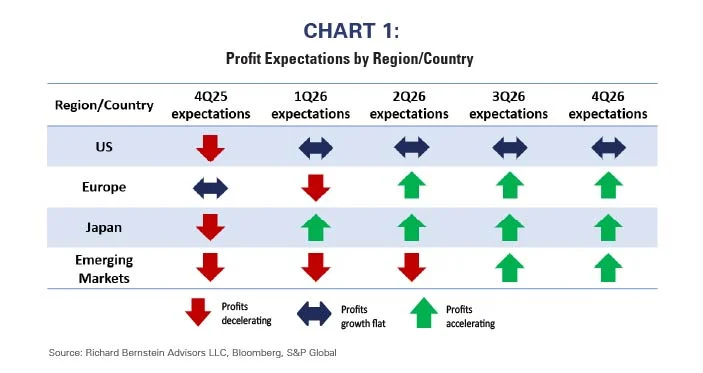
Investors need to remember that earnings growth matters far more than earnings levels. Today, profit expectations are accelerating across most major regions, while U.S. expectations appear to be flattening. That does not imply the U.S. is heading for an earnings downturn. Rather, it highlights an important shift: the gap between U.S. earnings momentum and the rest of the world is narrowing, and relative momentum tends to be a key driver of relative equity performance.
Developed international markets look particularly attractive from an earnings momentum standpoint as we move through 2026, while emerging markets appear positioned to catch up quickly after years of underperformance.
2) Scarcity of Capital:
Over the long term, return on invested capital is usually highest where capital is scarce. You want to be the lone banker in a town of a thousand borrowers, not one of a thousand bankers competing for a single borrower.
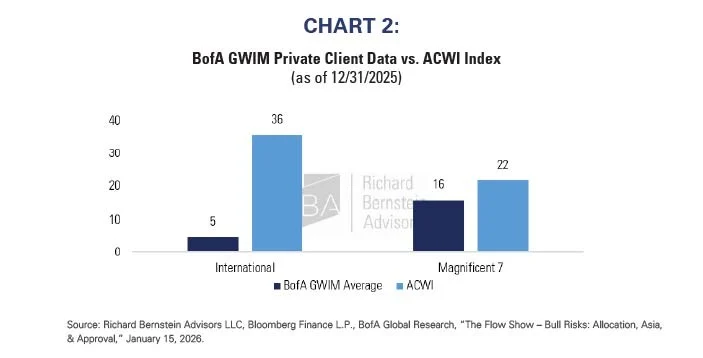
International markets appear unusually starved for capital today. BofA GWIM private client data shows investors hold just 5% of their portfolios in international equities, versus roughly 36% weight in ACWI. By contrast, investors hold 16% in the Magnificent 7 versus a 22% weight in ACWI. In other words, both allocations sit below global market weights, but the gap is far wider for international equities, highlighting a meaningful underweight and capital scarcity that could continue to support strong forward returns.
3) Last Cycle Leadership Rarely Repeats:
Market leadership is shaped by the macro backdrop, and that backdrop rarely carries cleanly from one cycle to the next. When the underlying conditions change, the winners usually change with them.
The last cycle rewarded long-duration assets. Concentrated earnings growth, low inflation, quantitative easing, and low interest rates created a powerful tailwind for mega-cap growth and private markets, including venture capital, private equity, and private credit.
The next cycle is starting to look very different. Broader earnings growth, stickier inflation, reduced policy support, and higher interest rates favor a different set of winners: international markets, commodity-oriented and inflation-sensitive countries and sectors, small caps, industrials, and value.
In our view, the opportunity is in areas that combine reasonable valuations with attractive forward return potential, particularly where positioning remains light and fundamentals are improving.
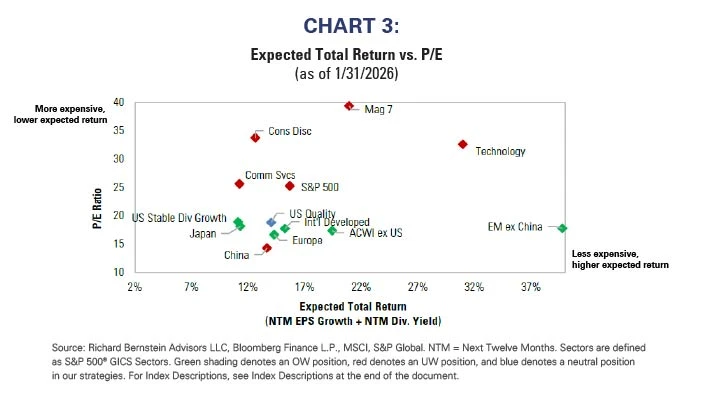
The breadth of opportunities in 2026 and beyond is unlike anything we’ve seen since 2010. While investor attention remains concentrated in AI, crypto, and other crowded trades, leadership is already shifting toward under-owned regions with improving fundamentals. RBA portfolios are positioned to capture that rotation through an emphasis on developed international equities, selective emerging markets, and more cyclically oriented exposures consistent with the current macro regime. In many ways, it echoes 2010, when we maintained an overweight to U.S. equities while sentiment was pessimistic, valuations were compelling, and fundamentals were beginning to turn, a setup that ultimately proved right as U.S. leadership emerged.
Sign up for our Newsletter!